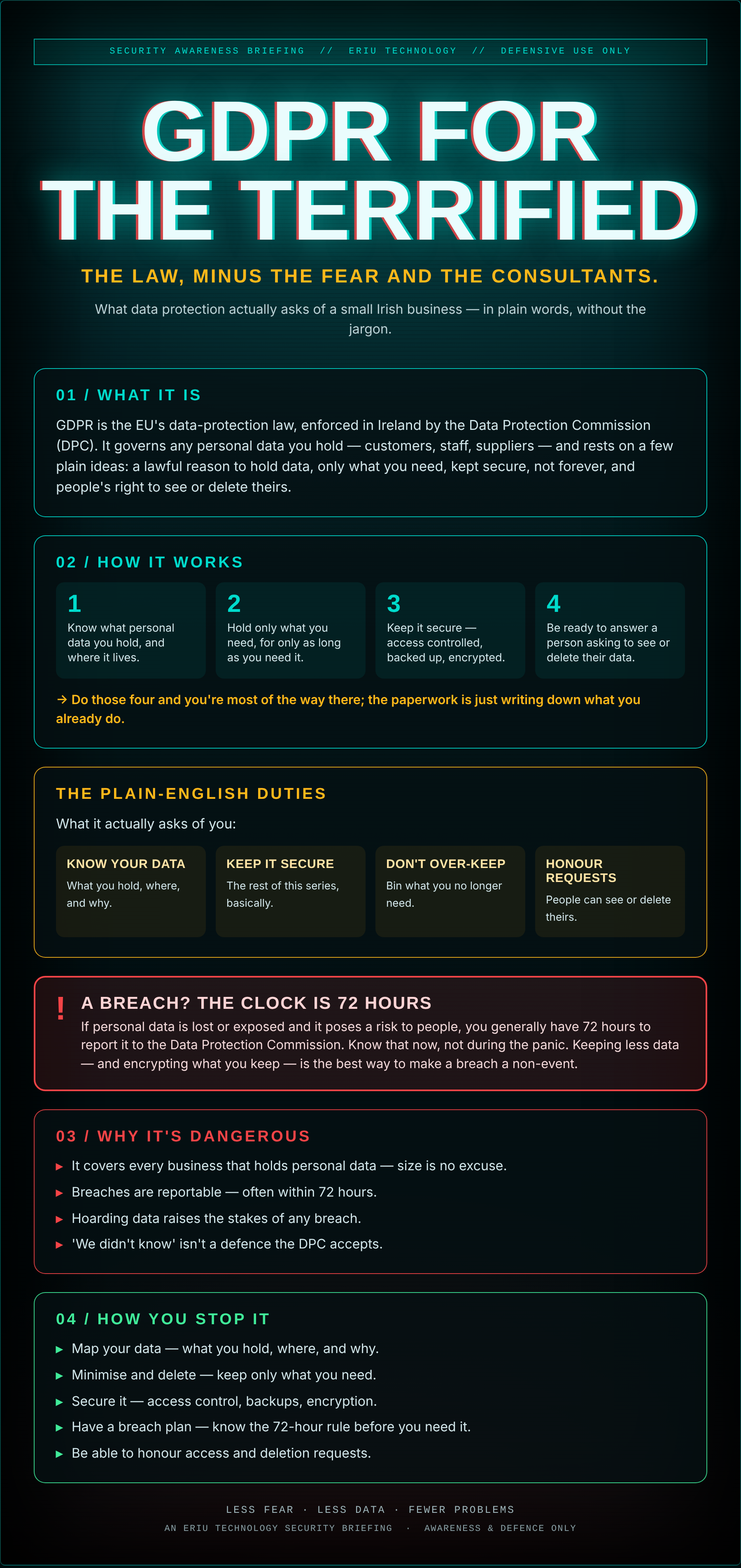
The letters 'GDPR' tend to land like a solicitor's letter: vaguely threatening, probably expensive, best not thought about. So most small businesses don't — until something goes wrong.
Here's the reassuring bit. For an ordinary small business, GDPR isn't a maze — it's mostly common sense written down: know what personal data you hold, keep it safe, don't hoard it forever, and be straight with people about it.
You don't need a consultant and a ring-binder. You need to know where the data is and treat it like it matters — because to the person it's about, it does.
What it actually is
GDPR is the EU's data-protection law, enforced in Ireland by the Data Protection Commission (DPC). It governs any personal data you hold — customers, staff, suppliers — and rests on a few plain ideas: a lawful reason to hold data, only what you need, kept secure, not forever, and people's right to see or delete theirs.
01How it works
- Know what personal data you hold, and where it lives.
- Hold only what you need, for only as long as you need it.
- Keep it secure — access controlled, backed up, encrypted.
- Be ready to answer a person asking to see or delete their data.
→ Do those four and you're most of the way there; the paperwork is just writing down what you already do.
The plain-English duties
What it actually asks of you:
- Know your data — What you hold, where, and why.
- Keep it secure — The rest of this series, basically.
- Don't over-keep — Bin what you no longer need.
- Honour requests — People can see or delete theirs.
If personal data is lost or exposed and it poses a risk to people, you generally have 72 hours to report it to the Data Protection Commission. Know that now, not during the panic. Keeping less data — and encrypting what you keep — is the best way to make a breach a non-event.
02Why it's dangerous
- It covers every business that holds personal data — size is no excuse.
- Breaches are reportable — often within 72 hours.
- Hoarding data raises the stakes of any breach.
- 'We didn't know' isn't a defence the DPC accepts.
03How you stop it
- Map your data — what you hold, where, and why.
- Minimise and delete — keep only what you need.
- Secure it — access control, backups, encryption.
- Have a breach plan — know the 72-hour rule before you need it.
- Be able to honour access and deletion requests.
An Eriu Technology security briefing. Awareness and defence only. Not legal advice — but enough to stop GDPR being the thing you're afraid to look at.