You come in on Monday and every file is gibberish. On the desktop, a note: your data is encrypted, pay to get it back.
You're grand, you think — there's a backup. Then you go to restore it and find it stopped running in March, or it's encrypted too, or nobody ever actually tried bringing it back. That's the real gut-punch.
Ransomware doesn't just lock your files. It bets that your backup is a box nobody's opened in a year.
What it actually is
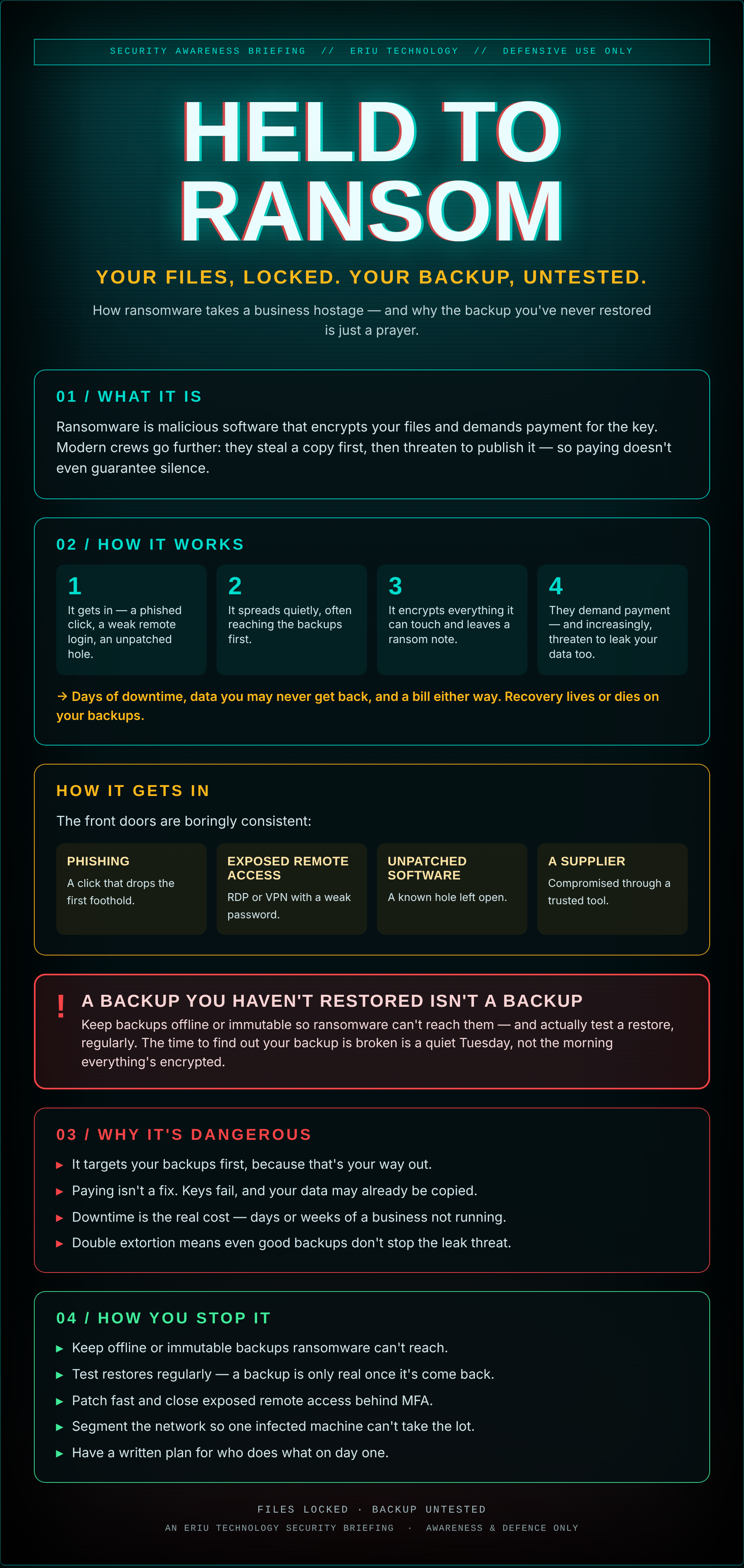
Ransomware is malicious software that encrypts your files and demands payment for the key. Modern crews go further: they steal a copy first, then threaten to publish it — so paying doesn't even guarantee silence.
01How it works
- It gets in — a phished click, a weak remote login, an unpatched hole.
- It spreads quietly, often reaching the backups first.
- It encrypts everything it can touch and leaves a ransom note.
- They demand payment — and increasingly, threaten to leak your data too.
→ Days of downtime, data you may never get back, and a bill either way. Recovery lives or dies on your backups.
How it gets in
The front doors are boringly consistent:
- Phishing — A click that drops the first foothold.
- Exposed remote access — RDP or VPN with a weak password.
- Unpatched software — A known hole left open.
- A supplier — Compromised through a trusted tool.
Keep backups offline or immutable so ransomware can't reach them — and actually test a restore, regularly. The time to find out your backup is broken is a quiet Tuesday, not the morning everything's encrypted.
02Why it's dangerous
- It targets your backups first, because that's your way out.
- Paying isn't a fix. Keys fail, and your data may already be copied.
- Downtime is the real cost — days or weeks of a business not running.
- Double extortion means even good backups don't stop the leak threat.
03How you stop it
- Keep offline or immutable backups ransomware can't reach.
- Test restores regularly — a backup is only real once it's come back.
- Patch fast and close exposed remote access behind MFA.
- Segment the network so one infected machine can't take the lot.
- Have a written plan for who does what on day one.
An Eriu Technology security briefing. Awareness and defence only. The difference between a bad week and a dead business is a backup you've actually tested.